Tomorrow Is Eid. Here's What That Actually Means.
A software engineer's window into Eid al-Fitr. Not a lecture on Islam. Just what tonight and tomorrow actually look like from the inside.
Right now, as I write this, my mom is in the kitchen. She's been there since noon.
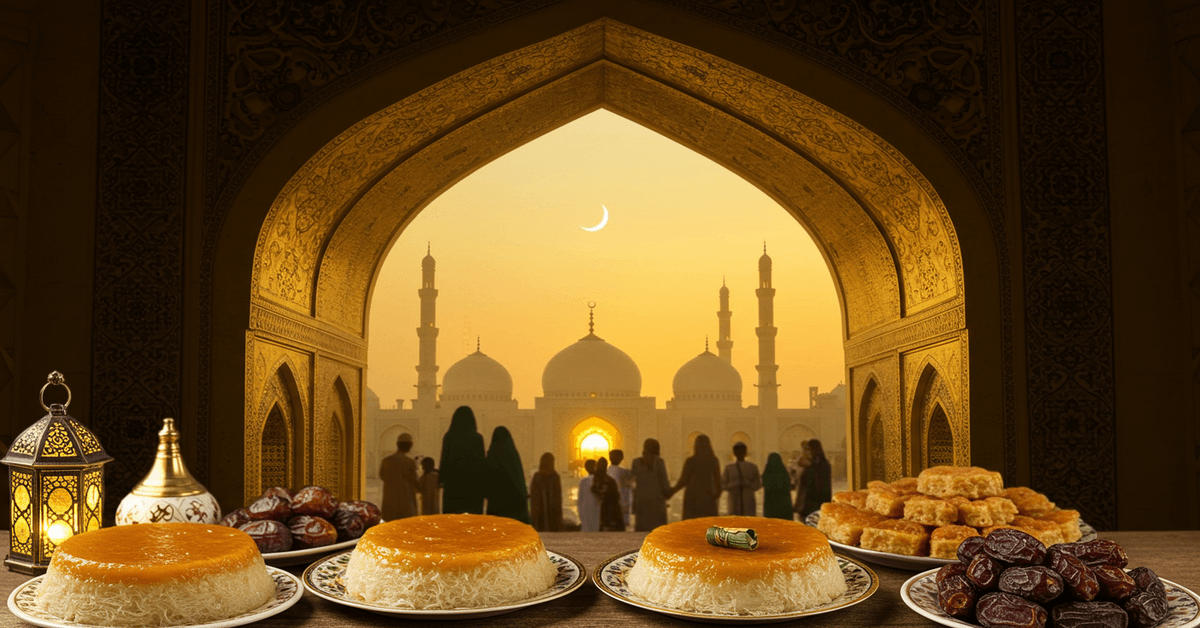
Not because someone told her to. Because tomorrow is Eid, and she's making sheer khurma, and if you've ever tasted it, you understand why nobody needs to be told. Vermicelli, milk, cardamom, dates, pistachios. The house smells like someone bottled celebration.
Tomorrow morning, I'll put on new clothes. My dad will too. We'll walk to the mosque for the Eid prayer, shoulder to shoulder with a few thousand other people. Strangers will hug me. I'll hug them back. There's something about that moment, rows and rows of people standing together, that makes the rest of the year's noise go quiet.
Then we'll go home and eat until it hurts.
That's Eid.
What came before
Eid al-Fitr marks the end of Ramadan, the month where Muslims fast from sunrise to sunset. Thirty days. No food, no water, nothing, while the sun is up.
People hear "no water" and flinch. I get it. It sounds brutal from the outside.
From the inside, it's different. The first few days are rough, sure. Your body protests. You get that 3 PM headache that laughs at you. But somewhere around day five or six, something shifts. You stop thinking about lunch. You notice things. The call to prayer hits differently when your stomach is empty. Conversations get more honest when you can't hide behind a coffee cup.
Fasting isn't punishment. It's a reset. You spend a month remembering what hunger actually feels like, and it changes how you see the guy selling fruit on the corner, the coworker who skips lunch because they can't afford it, the neighbor you never talk to.
By day thirty, you're not desperate for it to end. You're lighter. And I don't mean your weight.
The day itself
Eid morning has a specific energy. If you grew up with it, you know. If you didn't, imagine Christmas morning mixed with a family reunion mixed with the last day of school.
Kids wake up early because they know what's coming: Eidi. Cash gifts from every uncle, aunt, and family friend. My nieces have a system. They know exactly which uncle gives the most and they hit him first. (I'm not that uncle. Not yet.)
The prayer is massive. In Pakistan, entire fields get converted into open-air mosques. Thousands of people, all facing the same direction, all saying the same words. You stand next to people you've never met and it doesn't matter. For those twenty minutes, nobody cares about your job title or your car or your code review backlog.
After the prayer, it's hugs. Not the quick professional kind. Real ones. Eid Mubarak, Eid Mubarak, Eid Mubarak. Over and over. Grudges get dropped. Fights get squashed. That cousin you haven't talked to in six months? You'll call him. Not because you're told to. Because the day makes it feel stupid not to.
Then the food starts. And it doesn't stop.
What people get wrong
I work in tech. My LinkedIn has people from San Francisco, Berlin, Lagos, Karachi, Toronto. A mixed audience with mixed assumptions about what being Muslim means.
So let me clear up a few things.
"Islam oppresses women."
My mother runs our household. My sisters are engineers. My wife has a career she chose. The women in my family are the loudest voices in the room. This doesn't mean oppression doesn't exist anywhere in the Muslim world. It does. But blaming a religion for what cultures and governments do is like blaming open source for a company's bad code. The source material says something different from the implementation.
Khadijah, the Prophet Muhammad's first wife, was a businesswoman. She was his boss. She proposed to him. That was 1,400 years ago.
"Muslims are angry."
Eid is literally a holiday about gratitude and joy. We just spent thirty days practicing patience, self-control, and generosity. Tonight, people are delivering food packages to families who can't afford a proper Eid meal. That's not an anomaly. That's the whole point.
Zakat al-Fitr, the charity given before Eid prayer, is mandatory. Not optional. Not "it would be nice if you donated." You cannot pray the Eid prayer without first making sure the people around you can eat. The celebration isn't valid until the community is fed.
"It's all very serious and strict."
My uncle tells the same terrible jokes every Eid. Every single year. My cousins and I play cricket in the street after lunch, still in our good clothes, which our mothers hate. Kids run around with henna on their hands and chocolate on their faces. Old men sit in plastic chairs arguing about politics. Someone's phone is playing nasheeds too loud.
It's chaotic. It's warm. It's home.
"All Muslims are the same."
Eid in Pakistan looks different from Eid in Turkey, which looks different from Eid in Nigeria, which looks different from Eid in Indonesia. The prayer is the same. Everything else, the food, the clothes, the traditions, is local.
In Pakistan, it's biryani and sheer khurma. In Turkey, it's baklava. In Morocco, it's msemen with honey. In Malaysia, it's rendang.
1.8 billion people celebrate this. That's not a monolith. That's a quarter of the planet, each bringing their own kitchen to the table.
Why this is on a tech blog
Because you shouldn't have to go to a mosque or read a theology book to understand your coworker.
I've been in standups where someone asked why I seemed low-energy in the afternoon. Ramadan. I've had people look uncomfortable when I mentioned I was fasting. I've had well-meaning colleagues say things like "I could never do that" with a tone that meant "why would anyone do that."
The answer is: because it makes me better. More patient. More grateful. More aware of what I have and what others don't.
And Eid is the payoff. Not from God, not as a transaction. The payoff is that feeling tomorrow morning when I stand in that prayer, next to my father, and feel the exact same thing my grandfather felt, and his grandfather before him.
Some things don't need to be optimized.
Eid Mubarak. 🌙
Get new posts in your inbox
Architecture, performance, security. No spam.
Keep reading
Your coding agent is a slot machine. You're already pulling the lever.
There's a new name for something engineers have been feeling for a year: token anxiety. The compulsive urge to always be prompting, always shipping. This is what that actually is.
Ollama Just Became an OpenClaw Provider
Ollama 0.18 shipped with native OpenClaw integration. Local models now get tool calling, multi-agent workflows, and permission boundaries. No API costs, no data leaving your network.
Verification Debt: The Hidden Org Cost of AI-Generated Code
Amazon.com went down for six hours because of AI-assisted code changes. A week later, they required senior engineer sign-offs. LinearB analyzed 8.1 million pull requests and found AI code waits 4.6x longer for review and ships 19% slower. The productivity gains were a mirage.